Christian County Health Department announces measles case
Published 4:06 pm Thursday, November 5, 2026

|
Getting your Trinity Audio player ready...
|
Ozark, MO – A case of measles has been reported to the Christian County Health Department after a county resident tested positive for measles following an exposure to a case previously reported in another Missouri county. Those exposed are being contacted and asked to monitor for symptoms. No additional opportunities for public exposure have been reported.
“With this case, we can no longer view measles as a disease of faraway places or the distant past,” said Christian County Health Administrator Aaron Winslow. “It has arrived in our community. While it appears that this case will not ignite a community outbreak, due mainly to the exceptional efforts of state and local public health officials, we may not be so fortunate next time. While we will redouble our efforts to prepare for response, the best way to prevent community outbreaks and spare us from the negative health and economic impacts that have been seen in other states is to achieve community immunity through vaccination.”
All individuals with possible exposures should watch for the symptoms of measles for 21 days from the date of exposure and contact their local public health agency if symptoms appear. People who think they have measles should isolate themselves and call their health care provider before arriving to be evaluated and to receive care. It is important to let the healthcare facility and medical providers know of the concern for measles and to get instructions on how to come to the office for diagnosis without exposing other people to the virus.
Measles is a highly contagious viral illness that typically begins with fever, cough, runny nose and red and watery eyes. One person with measles can easily pass it on to 9 out of 10 people around them who are unvaccinated or do not have natural immunity. Symptoms typically appear 7-14 days after contact with the virus. Tiny white spots may appear inside the mouth 2-3 days after symptoms begin. Measles rash appears 3 to 5 days after the first symptoms. It usually begins as flat red spots that appear on the face at the hairline. They then spread downward to the neck, trunk, arms, legs and feet. Measles can cause severe health complications, including pneumonia, encephalitis (inflammation of the brain) and death. Measles can be transmitted by direct contact with infectious droplets or by airborne spread when an infected person breathes, coughs or sneezes. The virus can remain infectious in the air and on surfaces for up to 2 hours after an infected person leaves an area. People who are infected will begin to have symptoms on average 1- 2 weeks after being exposed to a person with measles.
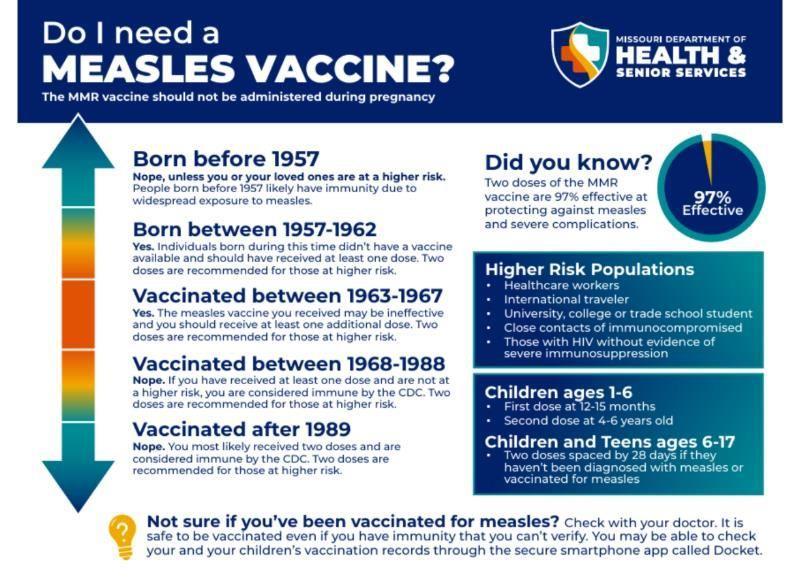
The best way to prevent getting sick is to be immunized with two doses of a measles-containing vaccine, which is primarily administered as the combination measles-mumps-rubella or MMR vaccine. Two doses of the MMR vaccine provide 97 percent protection from measles infections. Each MMR dose lowers the risk of infection and the severity of illness if infected. A small number of vaccinated people can occasionally develop measles. In these cases, the symptoms are generally milder, and they are less likely to have severe disease symptoms and spread the virus to other people. DHSS and the CDC recommend children receive one dose of MMR at 12 to 15 months of age and another at 4 to 6 years. Unvaccinated adults can also receive a “catch-up” MMR vaccination.
Measles can be especially dangerous for pregnant women and their unborn babies. Children too young to be vaccinated are more likely to have severe complications if they get infected with the measles virus.
Health care providers can find recommendations for infection control and diagnostic testing in the health alert issued on Sept. 4. Providers should report any suspected cases to their local health department immediately, preferably while the patient is still with the provider.
More information about measles and county-level MMR vaccination rates can be found at Health.Mo.Gov/Measles. If you have any questions, contact the Christian County Health Department at (417) 581-7285.